Commercial HVAC installation is more than setting equipment
A good commercial HVAC installation is not only about the rooftop unit, furnace, heat pump, or air handler that people notice first. The work behind the ceiling matters just as much. Duct connections, insulated runs, piping, hangers, access space, wiring routes, and coordination with the building structure all affect how the system performs and how easy it will be to service later.
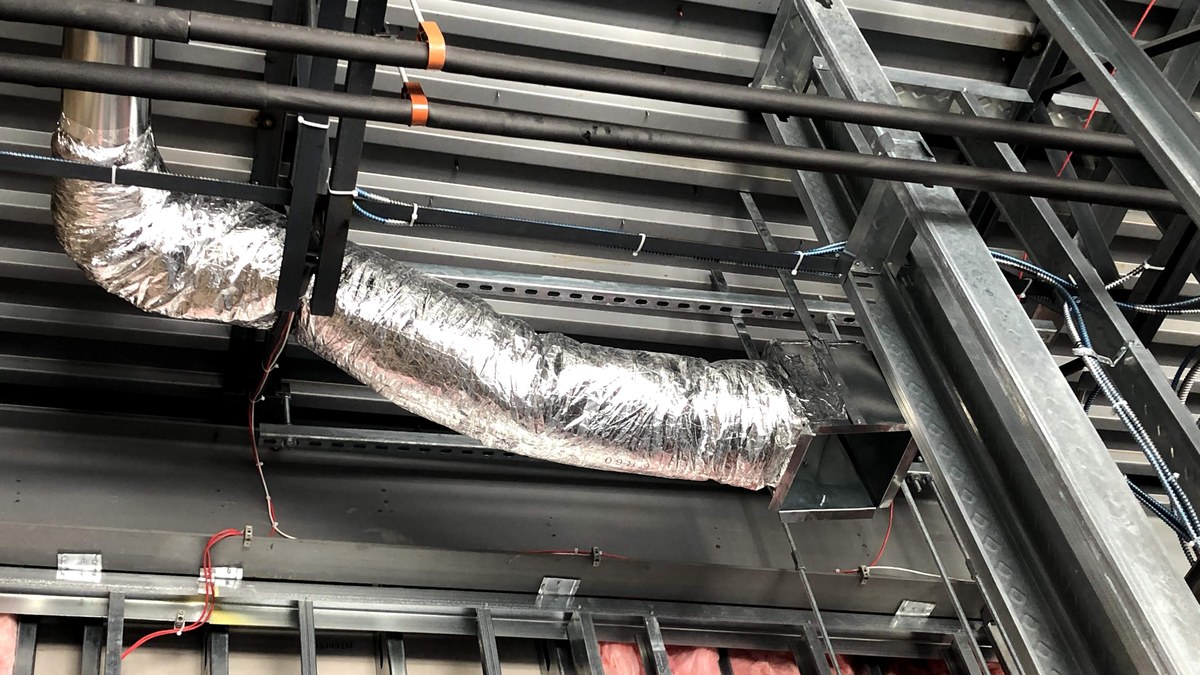
The photo for this post shows an above-ceiling mechanical rough-in with ductwork, piping, supports, and electrical runs. It is a good reminder for business owners and property managers: the hidden parts of an HVAC system can make the difference between a system that is practical to maintain and one that becomes frustrating every time service is needed.
For restaurants, offices, retail spaces, multifamily common areas, and light commercial buildings around Methuen, the Merrimack Valley, and Southern New Hampshire, planning these details early helps protect comfort, uptime, and future repair access.
Why rough-in quality matters for businesses
Commercial spaces are different from houses. A small comfort problem can affect employees, customers, tenants, product quality, or daily operations. If ductwork is poorly routed, if piping is difficult to reach, or if access panels are blocked by framing and finishes, the result may not show up immediately. It often shows up later as uneven temperatures, noisy operation, longer service visits, or repairs that require opening ceilings and moving obstacles.
Clean rough-in work helps the system do what it was designed to do. Air has to move through the right paths. Refrigerant, condensate, gas, or hydronic lines need proper support and safe routing. Controls and electrical components need to be reachable. The system also needs enough clearance for filter changes, drain cleaning, inspections, and troubleshooting.
That is why commercial HVAC installation should be planned with serviceability in mind from the beginning.
Access is not an afterthought
One of the most common issues in commercial mechanical spaces is limited access. A system might technically fit, but that does not mean it will be easy to maintain. If a technician cannot reach a valve, drain, control box, damper, filter rack, or connection point, simple maintenance can become a bigger job than it should be.
Good access planning considers questions like:
- Can filters and service panels be reached safely?
- Is there room to inspect duct connections and insulation?
- Are lines supported without blocking future service paths?
- Can drains be cleaned without cutting into finished surfaces?
- Are shutoffs, dampers, and controls labeled and reachable?
For a business owner, this matters because service time is business time. Easier access can mean faster diagnosis, cleaner maintenance, and less disruption when something needs attention.
Ductwork and airflow affect comfort in every room
Ductwork is one of the main reasons a commercial HVAC system either feels balanced or frustrating. Even strong equipment can struggle if the air distribution side is not right. Kinked runs, undersized sections, poor sealing, missing insulation, or awkward routing can lead to hot and cold spots, weak airflow, condensation concerns, and higher energy waste.
During installation or renovation, it is worth paying attention to how air will move through the space. Offices, kitchens, dining areas, storage rooms, and customer areas may all have different loads. A restaurant kitchen has very different needs from a front dining room. A retail space with large glass exposure may need different balancing than an interior office.
NewGen HVAC approaches these systems practically: install and service the equipment in a way that supports the real use of the space, not just what looks acceptable on paper.
Supports, piping, and small details protect the system
The visible equipment gets the attention, but small details can prevent future problems. Proper hangers and supports reduce strain on ductwork and piping. Clean routing helps prevent vibration and accidental damage. Insulated sections help reduce unwanted heat gain, heat loss, or condensation in the wrong places.
Those details are especially important in commercial spaces where other trades may also be working above ceilings or near mechanical systems. HVAC, electrical, plumbing, fire protection, framing, and ceiling work all have to coexist. When the rough-in is organized, it is easier to identify issues and avoid accidental damage during future renovations.
Maintenance starts with the way the system was installed
Preventative maintenance is easier when the system was installed with the future in mind. A technician should be able to check obvious wear points, inspect drains, verify airflow, look for loose supports, check insulation, and access serviceable components without fighting the building.
For businesses, that can support:
- More consistent indoor comfort
- Fewer avoidable shutdowns
- Faster troubleshooting when problems happen
- Cleaner seasonal maintenance
- Better planning for repairs or replacement
No installation can guarantee that equipment will never fail. But a serviceable layout gives technicians a better chance to catch small problems before they become bigger disruptions.
When to call a commercial HVAC technician
If your business is dealing with uneven temperatures, weak airflow, water around equipment, unusual noise, rising energy use, or repeated service calls, the problem may not be only the main unit. The ductwork, access points, drains, controls, or piping layout may be part of the issue.
You should also consider a professional inspection before finishing a renovation or closing ceilings around mechanical work. It is much easier to correct access or routing issues before the space is fully finished.
For restaurants and food-service businesses, NewGen HVAC can also look at related needs such as commercial refrigeration and certain kitchen equipment service. That broader view helps when comfort, refrigeration, and operations all affect the same business day.
Local commercial HVAC help in Methuen, MA and Southern NH
NewGen HVAC / New Generation HVAC LLC is a family-run HVAC company based in Methuen, MA, serving businesses and homeowners across the Merrimack Valley and Southern New Hampshire. Since 2014, the team has helped local customers with residential HVAC, commercial HVAC, commercial refrigeration, and commercial kitchen equipment service.
If you are planning a commercial HVAC installation, renovating a space, or dealing with a system that is difficult to service, NewGen HVAC can take a practical look at the setup and explain the next steps clearly.
Request service or a free estimate at https://www.newgenhvac.com/contact/ or call (978) 876-8558. For equipment that cannot wait, ask about 24/7 emergency help.